|
|
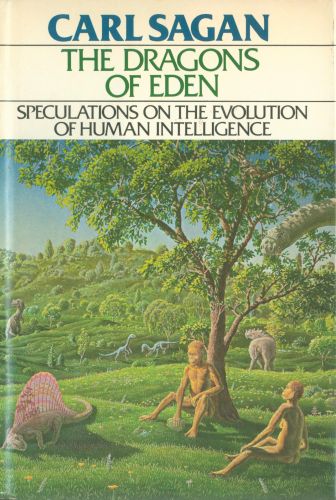
| Cover art by Donald S. Davis |
| THE DRAGONS OF EDEN: Speculations on the Evolution of Human Intelligence Carl Sagan New York: Random House, 1977 |
Rating: 5.0 High |
|||
| ISBN 0-394-41045-9 | 263pp. | HC/BWI 1 | $8.95 | |
| Page 21: | "With a few unimportant exceptions, the hereditary nucleic acid is always the molecule called DNA (deoxyribonucleic acid)." |
| These exceptions are never named. It would be fascinating to know what they are. |
| Page 22: | "In earlier times it was widely held that offspring could be produced by crosses between extremely different organisms. [Mythology omitted] And the Roman historian Pliny suggested that the ostrich, then newly discovered, was the result of a cross between a giraffe and a gnat. (It would, I suppose, have to be a female giraffe and a male gnat.)" |
| Sagan's dry wit is on display here. However, the Minotaur mention seems misplaced since all bets are off in mythology. |
| Page 28: | "...too much would go wrong too often it we had more genes." |
| Typo: S/B "if we had". |
| Page 34: | Diagram of the Sensory Homonculus |
| This diagram omits the ear. |
| Page 37: | "(Also shown is an intriguing exception: a small, ostrich-like [...] dinosaur..." |
| The case of the thoughtful theropod? |
| Page 39: | "But we cannot expect the correlation of mass ratio with intelligence to apply to the smallest animals, because the simplest 'housekeeping' functions of the brain must require some minimum brain mass." |
| Yes, but how much? |
| Page 42: | "This is an unimaginably large number, far greater, for example, than the total number of elementary particles (electrons and protons) in the entire universe, which is much less than 2 raised to the power 103." |
| Typo: S/B "2 raised to the power 1013". |
| Page 58: | "The fish stage even has gil slits, which are absolutely useless for the embryo who is nourished via the umbilical cord, but a necessity for human embryology: since gills were vital to our ancestors, we run through a gill stage in becoming human." |
| I think this S/B "a necessity for human ontogeny". This follows Ernst Haeckels's formulation, discredited now, that "ontogeny recapitulates phylogeny" — the embryo's development goes through every stage of evolution. |
| Page 70: | Diagram of the brain |
| The diagram shows no temporal lobe. Page 69 describes the temporal lobes as one of the four major brain regions. |
| Page 94: | "Man is probably the only organism on Earth with a relatively clear view of the inevitability of his own end." |
| I wonder if Dr. Sagan would hold that view today. |
| Page 99: | "The environment in which man evolved—in Africa in Plicene and Pleistocene times..." |
| Spelling: S/B "Pliocene". Compare p. 230. |
| Page 101: | "Holloway's casts of fossil skulls are made of rubber latex..." |
| Word order: S/B "latex rubber". |
| Page 168: | "We have already mentioned the ability of the brain to relocalize functions..." |
| King Carl? |
| Page 212: | "The speed of transmission of information in the circuitry of such computers is the velocity of light." |
| Not quite. |
| Page 216: | "...the game Space War, whose development and delights have been chronicled by Stuart Brand." |
| Spelling: S/B "Stewart Brand". See Bibliography page 241. |
| Page 230: | "...for example, if nonhuman primates with language have been exterminated by humans, while slightly less communicative apes ignored by our ancestors." |
| Missing word: S/B "slightly less communicative apes were ignored by". |

 To contact Chris Winter, send email to this address.