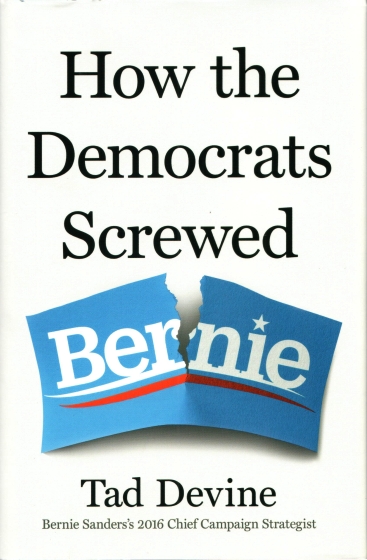
| HOW THE DEMOCRATS SCREWED BERNIE Tad Devine New York: Simon & Schuster, July 2026 |
Rating: 5.0 High |
|||
| ISBN-13 978-1668232286 | ||||
| ISBN-10 1668232286 | 244pp. | HC | $28.00 | |
Every Democrat currently serving in Congress should be required to read this book.1
It took me a long time to understand why tyranny, or authoritarianism, springs up so often in the real world. Nazi Germany is the canonical example for our time: the ultimate, unthinkable evil. But our time has seen tyrannies in many nations: Mao's China, Pol Pot's Cambodia, Stalin's Russia, Mussolini's Italy, Victor Orban's Hungary, Bolsonaro's Brazil... Some start with revolutions against another tyrant but then turn tyrannical themselves. Nicaragua and Cuba are two examples. And America, for all its virtues, has a history of supporting authoritarian governments.2
America itself has seen conditions approaching tyranny in individual states. Louisiana's Huey Long comes to mind. So do Gregg Abbott in Texas and Ron DeSantis in Florida. (It's odd how often such states are in the southeast.) But, despite shelves full of books warning it was possible, few really thought America as a whole would fall victim to such a takeover. Until 2016.
Today, I think it's safe to say, a majority of people know better. They can see the takeover happening right in front of their eyes. But the Republicans now holding power do not care about the majority of the people — and, sad to say, neither do many of the Democrats in Congress.
That is why Tad Devine, a lifelong member of, and political consultant to, the Democratic Party, felt compelled to write a book that many establishment Democrats consider heresy. Here, as an insider, he documents what the DNC and Hillary Clinton's camapign did in 2016.
We heard repeatedly from focus group respondents that they perceived Bernie as honest and Hillary as being too self-satisfied. They also saw him as being independent of special interests. They frequently talked about Clinton's ties to corporations and Wall Street, and some expressed a feeling that she was too polished and overprepared. We saw that Bernie's message of a rigged economy held in place by a corrupt system of campaign finance was resonating powerfully with target voters, as was Bernie's criminal justice and police reform agenda, especially with young and African American voters. Also, Bernie gave a strong speech on the water crisis in Flint, which we filmed and quickly turned into an ad that proved to be compelling to Michigan voters. Michigan also became an antidote to the perception that Bernie held no appeal for African American voters. In Michigan and some other northern states, at least, it became clear that he could compete with Clinton for those stalwart Democratic coalition voters. Most importantly, winning Michigan stopped the pressure that Reid and Schumer could have exerted against Bernie, at least through March. Our win in Wisconsin would do the same a month later. But the most valuable insight from Bernie's victories in the Michigan and Wisconsin primaries was ignored by the establishment, at the time and to this day: Those victories suggested strongly that it was Bernie, not Trump, who would have prevailed in the 2016 general election. – Pages 167-8 |
The way the Democratic establishment reacted to Bernie Sanders is emblematic of the way they continue to react to compelling candidates they consider to be party outsiders, even when they are popular. The same pattern played out with Representative Alexandria Ocasio-Cortez and, more recently, New York City Mayor Zohran Mamdani. Each was greeted with horrified pearl-clutching, deliberate obstruction, and a clinging to exclusionary and anachronistic rules. This explains, in part, why a party that should have a winning message has lost so much ground in the recent past. We may have been able to console ourselves with the popular vote victories of Al Gore and Hillary Clinton—Pyrrhic though they were—but we have learned little from those experiences when we lost elections in a nation where more voters supported us. Now, it seems, our aging leadership has constructed a self-contained system strategically designed to reinforce their own power, as rank-and-file Democrats continue to erect barriers against new talent—and, perforce, new voters. Bernie's 2016 presidential run offers a vivid illustration of what happens when a popular insurgent campaign competes against the capital "E" Establishment. When the insurgent starts to gain ground, the Establishment will do anything to stop the momentum. When the enthusiasm of voters for the insurgent seems organic and genuine, the Establishment will devise ways of undermining it. And if they can't manage to do this by winning the debate and competing in the marketplace of ideas, they marshal the entrenched forces of a rigged system—ranging from how election funds are distributed to how and when debates are scheduled. *
* * I can understand how many establishment Democrats would consider it heresy that a guy who has been a team player for decades would first work for a democratic socialist and The intent of this book, however, is not to "pile on," but to deliver an important message for the Democrats and all voters who want an alternative to the Trump GOP. It's a message the party needs to hear if they want to have any hope of reasserting their relevance, attracting new voters, and nurturing new talent. – Pages 2-3 & 4-5 |
As a major player in the 2016 Bernie Sanders campaign, Tad Devine observed the machinations of the Clinton campaign and the DNC. In this book, he documents them in detail. While important, those details are too complicated to cover in this review, and doing so here would serve no purpose; it would only distract from Tad Devine's urgent message. By now it is well known that Bernie's campaign was sabotaged by the Democratic establishment. Similar behavior is easily seen today, as in the DNC's reluctance to release their postmortem on the 2024 campaign which found that ignoring the groundswell of pro-Palestinian sentiment was a factor in their loss, and in their desperate denunciations of Zohran Mamdani.
The book is well written and I noticed no factual mistakes. There are a few mistakes in grammar, but not enough to matter. An Epilogue discusses ways the Democrats can improve their electoral operation. There are chapter-by-chapter end notes and an excellent index. I give this book full marks and recommend it, but I do not consider it a must read — except, as I mentioned above, for members of the Democratic establishment. Let me reiterate that:

 To contact Chris Winter, send email to this address.