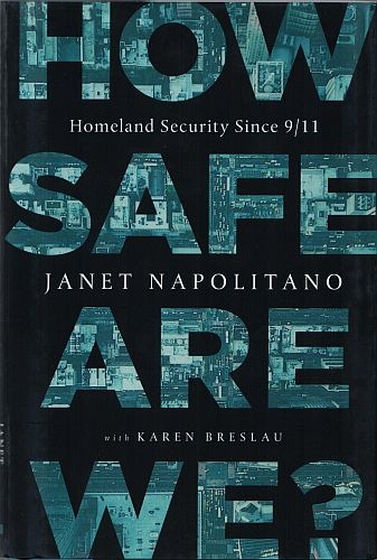
| HOW SAFE ARE WE? Homeland Security Since 9/11 Janet Napolitano & Karen Breslau New York: PublicAffairs, 2019 |
Rating: 5.0 High |
|||
| ISBN-13 978-1-54176222-0 | ||||
| ISBN-10 1541762223 | 215pp. | HC | $26.00 | |
In this book, Janet Napolitano recounts her transition from Governor of Arizona to Secretary of the United States Department of Homeland Security (DHS), the third person to hold that post after Tom Ridge and Michael Chertoff. DHS was created after the attacks of 11 September 20011 with the purpose of identifying and fixing the failures that permitted those attacks to happen. It was a big job, all the more so because of how many people's feathers it ruffled.
The 9/11 attacks changed the way we fly, protect our borders, investigate crime, and gather government information. They changed the way we organize the federal government itself, the economy, and even the way we watch the news on television. (The nonstop news ticker screen crawl was born to handle the torrent of information that day.) The 9/11 attacks shook the American psyche too, in ways that continue to reverberate. It had been nearly sixty years since the Japanese bombed Pearl Harbor, and for the first time in the lives of most Americans, we had to struggle with the realization that we were no longer safe from attack by a foreign entity within the borders of the United States. This altered our expectations of what our government can and cannot do for us. It affected our politics; it challenged our conception of ourselves as the world's most open society. *
* * Think of this book as an American report card. What has worked and what has not? What are the social, political, and economic costs of that progress? Where are our biggest vulnerabilities today, and how do we repair them? What are the risks we must accept if we are to remain a free and open society? What should government do for us, and what must each of us do for ourselves and our neighbors in the event of emergency? Most importantly, are we safer and more resilient today that we were on September 11, 2001? – Pages 1-2 |
More than two dozen separate agencies were combined under the umbrella of the new cabinet department, and there were significant growing pains involved. That the process worked as well as it did is a testament to the abilities of its first two leaders — and to the 9/11 Commission which, in the face of considerable partisan opposition, studied the attacks and government responses, and unanimously delivered in 2003 its 41 recommendations.2 Janet Napolitano continued that progress under the Obama administration from 2009 to 2013. Her contributions can be summed up thus:
Her term at DHS (2009-2013) was not without its mistakes. She covers the major ones here. But in the main her record stands as one of success. For example, she created the "PreCheck" process that, in addition to saving many travelers from aggravation at airports, reduced the burden on TSA employees and thereby improved overall screening efficiency. In the final section of the book, she lays out areas that need improvement. Cybersecurity stands out as most urgent. It is followed by better preparation against pandemics and by more comprehensive action on climate change. She also emphasizes preparing the public to respond more effectively in disasters, noting that residents of an area are often able to deliver immediate help to local victims — though this certainly will not eliminate the need for state disaster agencies and FEMA.
She comes across in the book as a pragmatic problem-solver. And, although not given to scathing retorts, she can effectively skewer those dedicated to partisan conflict. One example:
I remember one time testifying before the House Judiciary Committee. Representative Louie Gohmert of Texas, a leader in the Tea Party movement, asked a long, convoluted "question" (about what I do not recall). When I said that I wanted to break my response into two parts, Gohmert thundered, "I don't have time for answers!" – Page 86 |
She writes clearly and the narrative contains very few grammatical errors. I don't recall any errors of fact,4 although in several places I would have liked more information. One has to do with the controversial decision to use dispersants on the massive amount of oil released in the April 2010 Deepwater Horizon event (Macondo Well blowout).5 The index is good. I give it full marks, but though I consider it worth reading I won't call it a must read.

 To contact Chris Winter, send email to this address.