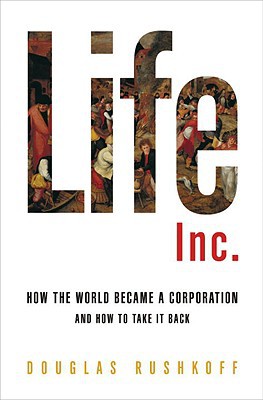
| LIFE INC. How the World Became a Corporation and How To Take It Back Douglas Rushkoff New York: Random House, 2009 |
Rating: 5.0 High |
|||
| ISBN-13 978-1-4000-6689-6 | ||||
| ISBN-10 1-4000-6689-1 | 274pp. | HC | $26.00 | |
The meeting will come to order.
"The premise for an industrial society rested in the ability for corporations to secure cheap and willing labor. Today, this means outsourcing. But originally it meant creating a compliant workforce at home, however coercively it had to be done. In order to be controlled, the teeming masses would be broken down into a mass of teeming individuals." After the Civil War and the ascendance of the railroad corporations, America changed scale. Local merchants and farmers were consolidated into larger industries. Small businessmen were overwhelmed by big companies and the 'robber barons' who owned them. Free enterprise had always meant the right of individuals to pursue their private economic activities in a highly local, human-scaled marketplace. Now it was growing out of control, favoring the interests of a tiny élite of corporate chiefs over everyone and everything else. – Pages 100-101 |
"The only privilege corporations were still denied was that of personhood itself. If only corporations could get a court to consider them people, they would be entitled to all the rights that real people got under the Constitution and the Bill of Rights. The rail companies understood this well, and fought for the 'personhood' argument in every court case they entered—whether it applied or not. The passage of the Fourteenth Amendment, written to guarantee the rights of citizenship to former slaves, gave corporate lawyers the legal framework to make their cases. For reasons historians can't quite articulate, the Amendment uses the phrase 'persons' instead of 'natural persons.' Corporations argued that this was because it was meant to include their own, non-natural personhood. In their opinions, justices repeatedly scolded corporate lawyers for attempting to exploit a law written on behalf of emancipated slaves. But the corporations had patience, and opportunistically sought out every leak and crack in the system."
"Finally, in 1886, in a legal maneuver that has yet to be conclusively explained, a Supreme Court clerk with documented affinity for corporate interests incorrectly summarized an opinion in the headnotes of the decision in Santa Clara County v. Southern Pacific Railroad Company. The clerk wrote, 'The defendant corporations are persons within the intent of the clause in section I of the Fourteenth Amendment to the Constitution . . . which forbids a State to deny to any person within its jurisdiction the equal protection of the laws.' There was no legal basis for this statement, nor any discussion about it from the justices. From then on, however, corporations were free to claim the rights of personhood. The more precedents that were established, the more embedded the law became. Over the next twenty-five years, 307 Fourteenth Amendment cases went before the Supreme Court. Two hundred eight-eight of them were brought by corporations claiming their rights as natural persons." (pages 13-14)

 To contact Chris Winter, send email to this address.